
The Ultimate Guide to CVC Word Families
Teaching children to read is one of the most rewarding experiences, and understanding CVC word families is a vital step in their literacy journey. These word patterns make learning phonics simple, enjoyable, and effective. In this guide, we’ll break down what CVC word families are, explore examples, and provide creative teaching strategies to help early readers succeed.

What Are CVC Word Families?
CVC word families are groups of words that share the same ending sound and spelling pattern. Each word consists of a Consonant-Vowel-Consonant structure, making them simple for beginners to sound out and recognize. For example:
-at: cat, hat, mat, sat
-it: fit, hit, lit, sit
-an: can, fan, man, pan
These families provide a predictable framework that helps children identify patterns, build confidence, and develop phonics skills.
Why Are CVC Word Families Important?
1. Pattern Recognition: Children learn to spot similarities in words, strengthening their decoding skills.
2. Rhyming Practice: Words in the same family rhyme, which enhances phonemic awareness.
3. Vocabulary Building: They provide a foundation for more complex word structures.
4. Boosts Confidence: Mastering CVC words gives children a sense of accomplishment, motivating them to learn more.
Common Examples of CVC Word Families
Here’s a handy list of popular CVC word families you can introduce to early readers:
| Word Family | Examples |
|---|---|
| -at Family | cat, bat, mat, rat, sat |
| -an Family | man, fan, tan, pan, ran |
| -et Family | net, set, get, bet, pet |
| -it Family | sit, fit, lit, hit, kit |
| -ot Family | hot, pot, lot, not, dot |
| -ug Family | mug, bug, rug, tug, hug |
| -en Family | pen, hen, ten, men, den |
6 Fun Activities to Teach CVC Word Families
Engaging children in fun and interactive activities is a great way to reinforce CVC word families. Here are six creative activities you can use to make learning enjoyable and effective:
1. Tap, Blend, and Read
This activity focuses on phonemic awareness and blending skills.
What You Need :
A set of flashcards with CVC words and corresponding pictures.
How to Play:
Show your child a flashcard with a CVC word (e.g., cat).
Have them tap their fingers on the table for each sound (/c/ /a/ /t/).
Encourage them to blend the sounds together and read the word aloud.
Flip the card to reveal the matching picture for instant feedback.
Benefits :
This activity enhances sound recognition and boosts blending fluency. You can use the printable worksheets provided as examples. (Right-click, then select 'save image as')
What You Need :
A set of flashcards with CVC words and corresponding pictures.
How it helps :
This activity enhances sound recognition and boosts blending fluency. You can use the printable worksheets provided as examples. (Right-click, then select 'save image as')
How to Play:
Show your child a flashcard with a CVC word (e.g., cat).
Have them tap their fingers on the table for each sound (/c/ /a/ /t/).
Encourage them to blend the sounds together and read the word aloud.
Flip the card to reveal the matching picture for instant feedback.


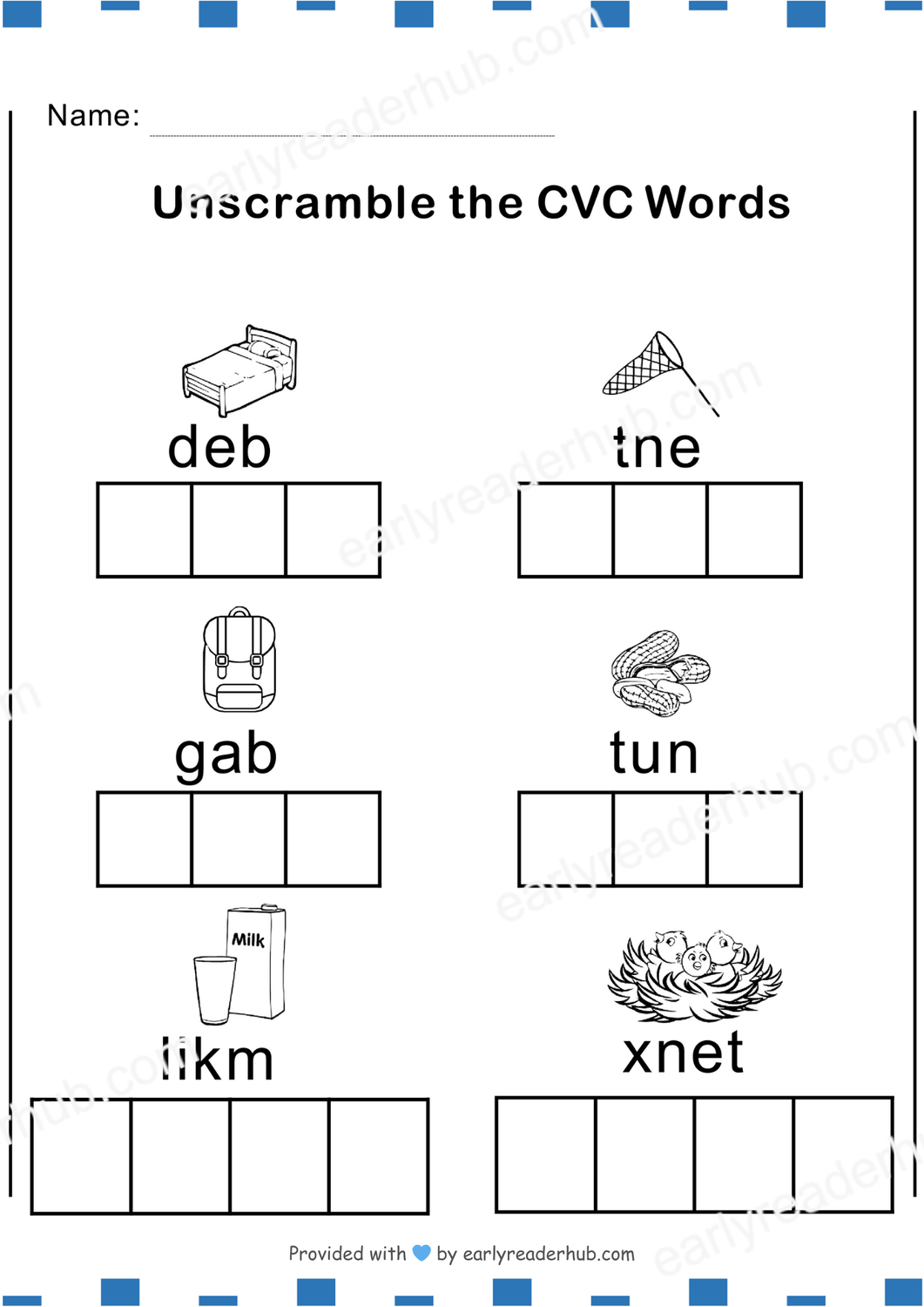
2. Unscramble the CVC Words
Challenge your child's problem-solving skills with this fun word scramble.
What You Need:
Scrambled CVC words on paper (e.g., tac, nap) and blank spaces for writing.
How to Play:
Provide your child with a sheet of scrambled words.
Ask them to rearrange the letters to form correct CVC words.
For added fun, include a small image of the word to give them a clue.
Benefits:
This task not only reinforces spelling but also boosts cognitive skills like logical thinking.
What You Need :
Scrambled CVC words on paper (e.g., tac, nap) and blank spaces for writing.
How it helps :
This task not only reinforces spelling but also boosts cognitive skills like logical thinking.
How to Play:
Provide your child with a sheet of scrambled words.
Ask them to rearrange the letters to form correct CVC words.
For added fun, include a small image of the word to give them a clue.

3. Middle Sound Match
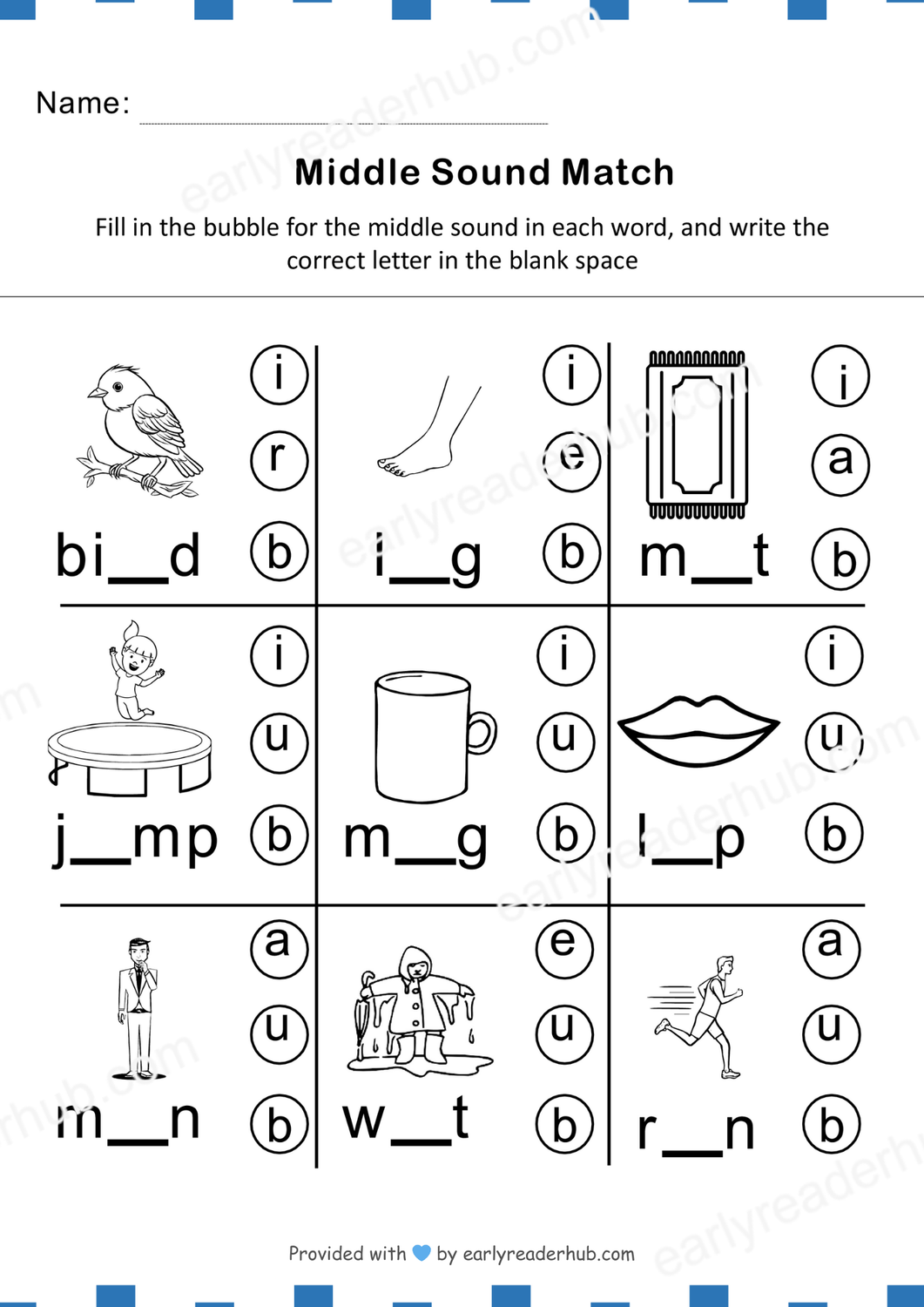
Focus on the often tricky vowel sounds with this activity.
What You Need:
A set of CVC words with missing vowels (e.g., c_t, h_t) and vowel tiles or flashcards.
How to Play:
Present your child with a set of incomplete words.
Provide them with vowel cards to fill in the blanks.
After completing the words, have them read each one aloud.
Benefits:
This activity hones in on vowel recognition and the ability to identify middle sounds.
What You Need :
Scrambled CVC words on paper (e.g., tac, nap) and blank spaces for writing.
How it helps :
This task not only reinforces spelling but also boosts cognitive skills like logical thinking.
How to Play:
Provide your child with a sheet of scrambled words.
Ask them to rearrange the letters to form correct CVC words.
For added fun, include a small image of the word to give them a clue.

4. CVC Word Fill In
Perfect for reinforcing spelling and understanding word patterns.
What You Need:
Worksheets with partially completed CVC words (e.g., c_ t, h_ t).
How to Play:
Hand out the worksheet and explain the task.
Ask your child to fill in the missing letters to complete the words.
Once the words are complete, they can draw a small picture next to each word to make it more fun.
Benefits:
This activity reinforces spelling and helps children identify common CVC patterns.
What You Need :
Worksheets with partially completed CVC words (e.g., c_ t, h_ t).
How it helps :
This activity reinforces spelling and helps children identify common CVC patterns.
How to Play:
Hand out the worksheet and explain the task.
Ask your child to fill in the missing letters to complete the words.
Once the words are complete, they can draw a small picture next to each word to make it more fun.


5. Color the CVC Word
Make learning vibrant and interactive with this coloring activity.
What You Need:
Printable coloring sheets with spaces labeled with CVC words and matching pictures.
How to Play:
Give your child a coloring sheet with pictures and corresponding CVC words (e.g., a picture of a dog with the word dog next to it).
Ask them to read the word aloud before coloring the matching picture.
Benefits:
This activity reinforces spelling and helps children identify common CVC patterns.
What You Need :
Worksheets with partially completed CVC words (e.g., c_ t, h_ t).
How it helps :
This activity reinforces spelling and helps children identify common CVC patterns.
How to Play:
Hand out the worksheet and explain the task.
Ask your child to fill in the missing letters to complete the words.
Once the words are complete, they can draw a small picture next to each word to make it more fun.


6. Read It, Write It, Color It
Turn reading practice into an artistic endeavor!
What You Need:
Printable worksheets with three sections: one for reading the word, one for writing it, and one for coloring.
How to Play:
Give your child a worksheet featuring a CVC word (e.g., bat).
Ask them to read the word aloud, write it in the space provided, and color the matching picture.
Encourage them to use different colors for each word to make it visually engaging.
Benefits:
This multi-step activity strengthens reading, writing, and fine motor skills.
What You Need :
Worksheets with partially completed CVC words (e.g., c_ t, h_ t).
How it helps :
This activity reinforces spelling and helps children identify common CVC patterns.
How to Play:
Hand out the worksheet and explain the task.
Ask your child to fill in the missing letters to complete the words.
Once the words are complete, they can draw a small picture next to each word to make it more fun.


Other Engaging Activities Ideas to Enhance CVC Word Family Learning
1. Rhyming Games:
Create rhyming flashcards with words from the same family.
Ask children to match words that rhyme, such as “bat” and “cat.”
Sing rhyming songs incorporating CVC word families.
2. Word Sorting
Write words from different families on cards.
Have children sort them into groups, like -at, -an, and -it.
This reinforces their ability to recognize patterns.
3. Word Family Puzzles
Create puzzles where children match word beginnings (e.g., "b," "c," "r") with endings (e.g., "-at," "-it").
Use magnetic letters for hands-on fun.
4. Write-and-Wipe Boards
Give children mini whiteboards to write and erase CVC words.
Provide word family endings and challenge them to create as many words as possible.
5. Story Time
Read books featuring CVC word families.
Highlight the patterns as you read, encouraging children to identify words in the same family.
6. Interactive Worksheets
Use worksheets where children trace, write, and color CVC words.
Include fill-in-the-blank exercises to practice identifying missing letters.
For even more engaging ways to reinforce CVC word family learning, check out our article on 10 Simple CVC Words Activities for Early Readers. They offer additional fun and effective strategies to support your little ones' reading journey!
How to Incorporate CVC Word Families into Daily Learning
1. Morning Routine: Begin the day with a quick word family matching game.
2. Bedtime Stories: Choose books with repetitive CVC words to reinforce learning.
3. DIY Flashcards: Make colorful flashcards together for added fun.
4. Outdoor Learning: Use chalk to write CVC words on the pavement and have children jump to the correct word family.
Ready to Take the Next Step?
Unlock even more learning opportunities with our Early Learning Activity Bundle! This bundle includes printable worksheets, engaging games, and step-by-step guides to make phonics fun and easy for your child.
Conclusion
CVC word families are a fantastic tool for introducing early reading concepts. With the right activities and a supportive environment, your child will be on the path to reading success in no time.
Copyright © Early Reader Hub 2026
All Rights Reserved
Copyright © Early Reader Hub 2025 All Rights Reserved